Welcome! Here is some additional info about tonight’s show!
PROGRAM
CELLO COUNTERPOINT
VALDINE RITCHIE MISHKIN | cello
VERMONT COUNTERPOINT
SARAH TIEDEMANN | flute
ELECTRIC COUNTERPOINT
DANIEL REYES LLINÁS | electric guitar
NEW YORK COUNTERPOINT
WILLIAM PYLE | soprano saxophone
All works by Steve Reich
PROGRAM NOTES (TAP TO READ MORE)
-
Vermont Counterpoint (1982) was commissioned by flutist Ransom Wilson and is dedicated to Betty Freeman. It is scored for three alto flutes, three flutes, three piccolos and one solo part all pre-record on tape, plus a live solo part. The live soloist plays alto flute, flute and piccolo and participates in the ongoing counterpoint as well as more extended melodies. The piece could be performed by eleven flutists but is intend primarily as a solo with tape. The duration is approximately ten minutes. In that comparatively short time four sections in four different keys, with the third in a slower tempo, are presented. The compositional techniques used are primarily building up canons between short repeating melodic patterns by substituting notes for rests and then playing melodies that result from their combination. These resulting melodies or melodic patterns then become the basis for the following section as the other surrounding parts in the contrapuntal web fade out. Though the techniques used include several that I discovered as early as 1967 the relatively fast rate of change (there are rarely more than three repeats of any bar), metric modulation into and out of a slower tempo, and relatively rapid changes of key may well create a more concentrated and concise impression.
-
New York Counterpoint was commissioned by The Fromm Music Foundation for clarinettist Richard Stolzman. It was composed during the summer of 1985. The duration is about 11 minutes. The piece is a continuation of the ideas found in Vermont Counterpoint (1982), where as soloist plays against a pre-recorded tape of him or her self. In New York Counterpoint the soloist pre-records ten clarinet and bass clarinet parts and then plays a final 11th part live against the tape. The compositional procedures include several that occur in my earlier music. The opening pulses ultimately come from the opening of Music for 18 Musicians (1976). The use of interlocking repeated melodic patterns played by multiples of the same instrument can be found in my earliest works, Piano Phase (for 2 pianos or 2 marimbas) and Violin Phase (for 4 violins) both from 1967. In the nature of the patterns, their combination harmonically, and in the faster rate of change, the piece reflects my recent works, particularly Sextet (1985). New York Counterpoint is in three movements: fast, slow, fast, played one after the other without pause. The change of tempo is abrupt and in the simple relation of 1:2. The piece is in the meter 3/2 = 6/4 (=12/8). As is often the case when I write in this meter, there is an ambiguity between whether one hears measures of 3 groups of 4 eight notes, or 4 groups of 3 eight notes. In the last movement of New York Counterpoint the bass clarinets function to accent first one and then the other of these possibilities while the upper clarinets essentially do not change. The effect, by change of accent, is to vary the perception of that which in fact is not changing.
-
Cello Counterpoint (2003) is scored for eight cellos and can be played by a soloist with the other parts pre-recorded or by a Cello Octet. It is in three movements, fast, slow fast.
The first and last movements are both based on a similar four chord cycle that moves ambiguously back and forth between c minor and Eb major. This harmonic cycle is treated extremely freely however, particularly in the third movement. As a matter of fact, what strikes me most about these movements is that they are generally the freest in structure of any I have ever written. The second, slow movement, is a canon in Eb minor involving, near the end of the movement, seven separate voices.
Cello Counterpoint is one of the most difficult pieces I have ever written, calling for extremely tight, fast moving rhythmic relationships not commonly found in the cello literature.
The piece is a little more than 11 minutes in duration and was co-commissioned by the Koussevitzky Foundation in the Library of Congress, the Royal Conservatory in The Hague and Leiden University, for cellist Maya Beiser.
-
Electric Counterpoint (1987) was commissioned by the Brooklyn Academy of Music’s Next Wave Festival for guitarist Pat Metheny. It was composed during the summer of 1987. The duration is about 15 minutes. It is the third in a series of pieces (first Vermont Counterpoint in 1982 for flutist Ransom Wilson followed by New York Counterpoint in 1985 for clarinettist Richard Stolzman) all dealing with a soloist playing against a pre-recorded tape of themselves. In Electric Counterpoint the soloist pre-records as many as 10 guitars and 2 electric bass parts and then plays the final 11th guitar part live against the tape. I would like to thank Pat Metheny for showing me how to improve the piece in terms of making it more idiomatic for the guitar.
Electric Counterpoint is in three movements; fast, slow, fast, played one after the other without pause. The first movement, after an introductory pulsing section where the harmonies of the movement are stated, uses a theme derived from Central African horn music that I became aware of through the ethnomusicologist Simha Arom. That theme is built up in eight voice canon and while the remaining two guitars and bass play pulsing harmonies the soloist plays melodic patterns that result from the contrapuntal interlocking of those eight pre-recorded guitars.
The second movement cuts the tempo in half, changes key and introduces a new theme, which is then slowly built up in nine guitars in canon. Once again two other guitars and bass supply harmony while the soloist brings out melodic patterns that result from the overall contrapuntal web.The third movement returns to the original tempo and key and introduces a new pattern in triple meter. After building up a four guitar canon two bass guitars enter suddenly to further stress the triple meter. The soloist then introduces a new series of strummed chords that are then built up in three guitar canon. When these are complete the soloist returns to melodic patterns that result from the overall counterpoint when suddenly the basses begin to change both key and meter back and forth between E minor and C minor and between 3/2 and 12/8 so that one hears first 3 groups of 4 eighth notes and then 4 groups of 3 eighth notes. These rhythmic and tonal changes speed up more and more rapidly until at the end the basses slowly fade out and the ambiguities are finally resolved in 12/8 and E minor.
3A STAFF
Evan Lewis | Executive Director
Sarah Tiedemann | Artistic Director
Will Pyle | Communications Director
Lori Trephibio | Production Manager
Maluhia Ose | Production Manager
3A BOARD OF DIRECTORS
Michael Reed, Interim Chair
Ted Clifford, Treasurer
Lars Campbell
Valdine Mishkin
Ross Seligman
Elaine Vote
Mike Rego
Evan Lewis, ex-officio
Sarah Tiedemann, ex-officio
BEHIND THE SCENES
Nathan Mutchler, Audio Engineer
Madeline Sorenson, graphic design
Terrellyn Faye Moffett, concert photography
NEW YORK COUNTERPOINT PRODUCTION
Andrew Schoen, baritone and tenor saxophone
Aaron Peterson, recording and mixing engineer
Ioannis Andriotis, mastering
HOPSCOTCH PORTLAND
Hopscotch is an immersive and experiential brand that brings together artists in collaborative environments to create unique, impactful, and distinct shared experiences. We believe art can be a vessel to tell stories and illuminate important messages of the past, present, and future. Hopscotch allows artists to showcase their works in sustainable and creative ways, encourages them to be inspired by new mediums, and empowers them to reach new audiences. We strongly believe in cultivating lasting relationships and a synergy with our staff, artists and the local communities we are in.

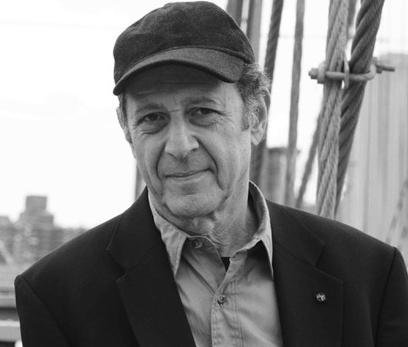
Steve Reich | composer
Steve Reich has been called “the most original musical thinker of our time” (The New Yorker) and “among the great composers of the century” (The New York Times). Starting in the 1960s, his pieces It’s Gonna Rain, Drumming, Music for 18 Musicians, Tehillim, Different Trains, and many others helped shift the aesthetic center of musical composition worldwide away from extreme complexity and towards rethinking pulsation and tonal attraction in new ways. He continues to influence younger generations of composers and mainstream musicians and artists all over the world.
A SPECIAL THANK YOU TO SEASON SPONSORS & DONORS
Ronni Lacroute, John Montague & Linda Hutchins, Oregon Arts Commission, The Miller Foundation, Amphion Foundation, The Brookby Foundation, The National Endowment for the Arts, The Aaron Copland Fund, Explore Tualatin Valley, The Rossotti Family Foundation and the Fred W. Fields Fund of Oregon Community Foundation, City of Portland Office of Arts & Culture, MJ Murdock Charitable Trust, Marie Lamfrom Charitable Foundation, Jackson Foundation.