
Welcome to Eras

Keep scrolling for more info about tonight’s show
 

PROGRAM

Kenji Bunch, Ralph's Old Records
David Lang, Sweet Air
Sarah Kirkland Snider, You Are Free

Intermission

Katrina Gimon, Unsung
Iman Habibi, Michael-Thomas Foumai, Kirsten Volness, Following Fire

90 minute program

Program notes

  • As a child, I often enjoyed listening to my father's cassette tape compilation of his old 78 records from the 1930s and '40s, titled simply in his handwriting "Ralph's Old Records." The lush harmonies, infectious syncopations, and witty lyrics of these Swing Era songs stayed with me long into adulthood, and have been a frequent influence in my own original compositions. As an homage to this influence, as well as to these fond childhood memories and to my dad himself, I wrote a set of five short vignettes for flute, clarinet, violin/viola, cello, and piano, called "Ralph's Old Records." Each movement draws inspiration from a specific song from my memory of my dad's collection, as follows:

    I. Chi-Chi-Hotcha-Watchee Stomp: A tribute to Vaughn Monroe's suave big band single "Down in the Chi-Chi Hotcha Watchee" begins this work, just as it begins the mix tape. The song is so etched into my brain that I actually never listened to it for reference while writing this piece.

    II. Celestial Debris: Harry James' rendition of the Hoagy Carmichael classic "Stardust" fades in and out of this tender nocturnal reverie.

    III. I Didn't Hear Nobody Pray: The country fiddle and firebrand sermonizing of Roy Acuff's "Wreck on the Highway" did not appear on Ralph's compilation, but is firmly placed in the "records" of colorful stories from his past. Having dropped out of high school and enlisted in the US Navy in 1945, Ralph became seriously ill with rheumatic fever and ended up in a military hospital in Georgia for several months. He vividly remembers, despite drifting in and out of consciousness in a hospital bed, the refrain of Acuff's singing on the radio, amidst the various blips and beeps of the medical equipment and the gauzy haze of his illness.

    IV. When I Grew Too Old To Dream, Dream, Dream, One More Dream Came True: In cataloguing the titles of the songs in this collection, I noticed the word "dream" was featured quite often, usually associated with a very sentimental, escapist love ballad. I also noticed the occasional appearance of a single by Spike Jones that would begin in this same romantic vein, only to descend into total wackiness and mayhem. In all his silliness, Jones' comic timing and creative timbral palette is truly original and brilliant.

    V. Off to the Foxes: In noticing a number of foxtrots in Dad's collection, I thought this was a fitting way to ride off into the sunset. Toward the end of this movement, the music suddenly halts, depicting perhaps the unheralded last spin of a record player, the fading away of the Swing Era into our collective memory, the inevitable disappearance of the so-called "Greatest Generation," or even the unknowable fragility of our own lives. Nevertheless, the music never really stops, and where there is music, there will always be dancing.

    Ralph's Old Records was commissioned and premiered July 6th, 2015, by Chamber Music Northwest at Reed College in Portland Oregon, and is dedicated to Ralph Bunch. The work is approximately 20 minutes in duration.

    —KENJI BUNCH

  • During a trip to the dentist my oldest son Isaac was given laughing gas. The dentist called it sweet air, a gentle name to take the fear out of having a cavity filled. It worked. My son experienced something—a drug—so comforting that it made him ignore all signs of unpleasantness. This seemed somehow musical to me. One of music’s traditional roles has always been to soothe the uneasy. I must say I have never been that interested in exploring this role. It is much easier to comfort the listener than to show why the listener might need to be comforted. My piece ”sweet air” tries to show a little bit of both. In ”sweet air,” simple, gentle musical fragments float by, leaving a faint haze of dissonance in their wake.

    ”sweet air” was written for the ensemble Sentieri Selvaggi for premiere at the Settembre Musica Festival in Torino, Italy, 9 September 1999. It is intended as a birthday present for Louis Andriessen – Happy sixtieth birthday, Louis!

    —David Lang

  • In 2015, Grand Valley State University New Music Ensemble, in a project called "Music In Their Words," commissioned nine composers, including me, to create works that utilized the speaking voice of a significant 20th-century composer, one who'd had a strong impact on their own work. I chose Arvo Pärt; when I first encountered contemporary music, he was one of the living composers whose music genuinely moved me. I had read a description of Pärt's music as "both infinite calm and a house on fire," which struck me as poignantly apt. The field recording of Pärt's voice comes from a delightfully earnest video interview he did with Icelandic experimental pop star Björk in the late '90s. As I listened to their conversation about the ways music in which music affects a listener, I heard a simple F major triad undulating in marimba, piano, and clarinet. From there, I tried to let the piece unfold relatively free of agenda or judgment, something I don't often do. The first performance direction is "somewhere between plaintive, tender, and anxious."

  • Unsung: If the Earth Could Sing is a major environmentally-inspired choral cycle for choir, percussion, and cello written by Katerina Gimon and with text by Lauren Peat. Unsung centers around the question “if the earth could sing, what would it tell us?”. The environmental crisis has been called the “biggest threat modern humans have ever faced” (United Nations, 2021) and Unsung aims to shed light on its impacts on Canadian landscapes in particular, using choral music as a form of advocacy and a voice for change. Each movement focuses on a different geographic region of Canada, moving loosely from East to West, and the choir's part is sung from the perspective of each landscape (or weather event, in the case of the first movement).

    To aid in characterizing each landscape, the choral writing in Unsung pushes beyond the traditional idiom incorporating extended techniques (ex. overtone singing, timbral alterations), graphic scoring, aleatory, spatialization, and texturally-driven writing.

    This major work was commissioned and premiered by Myriad Ensemble, conducted by Elise Naccarato, with the support of the Canada Council of the Arts.

  • Commissioned by Third Angle New Music for Eras

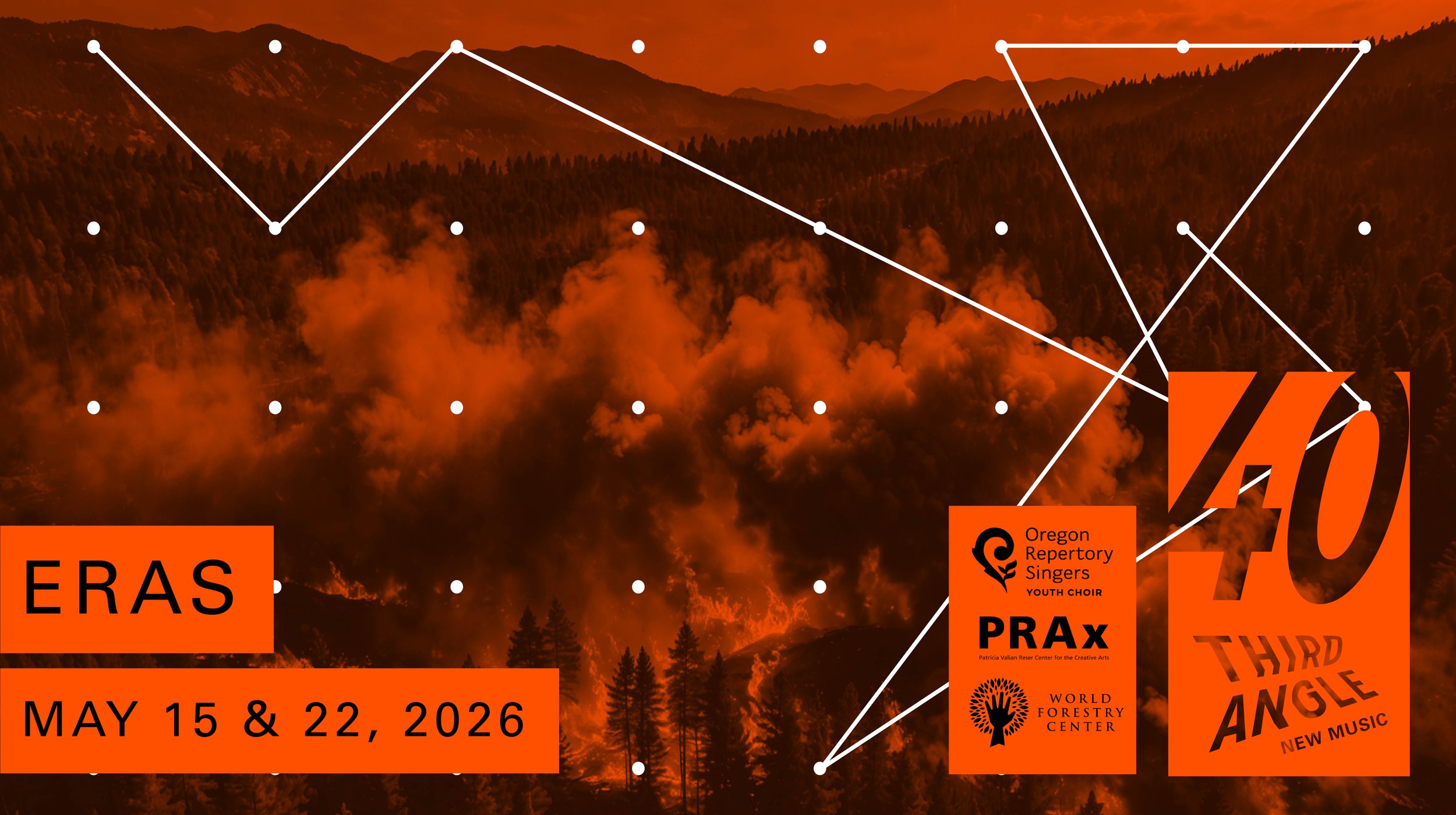
    Following Fire for children’s chorus and instrumental sextet is a musical triptych encapsulating wildfire– from bleak destruction to budding regrowth. The work derives its inspiration from the work of photographer David Paul Bayles and disturbance ecologist Frederick J Swanson who documented the long term impact of wildfire in the Cascade Range in their project also entitled “Following Fire.” In April 2025 students in the ORS Youth Choir were guided by Bayles and Swanson through their exhibit at World Forestry Center, and then spread out amongst the photos of skeletal trees and budding fireweed to write poetry. Kirsten Volness, Michael-Thomas Foumai and Iman Habibi set the student’s own poetry into music, layering perspectives that span generations.

    I. After Darkness
    Flames engulfed the world as we knew it

    Fire consumed green mothers on the hill

    You can feel their power after darkness

    You can hear their whispers and their will

    All is left when flames turn earth to ashes

    All is lost if we forget to learn

    Our mothers stand blackened on the hillside

    I wonder when it will be our turn

    II. After Fire

    Following the fire,

    Following the flames,

    Following the ashes of the darkened rain.

    The bark of the trees,

    The environment around,

    The air of the smoke,

    The stories of the untold.

    Tragedy of life,

    Resilience in the land,

    Pine among the floor,

    Bring back the forgotten lands.

    Following the fire,

    The colors of the trees,

    Environment adapting,

    Reconnect to the land and the sea.

    III. Then Light

    [...]

    From it though emerges a new light

    a golden flower, its center so (sunny and) bright

    as it fills the forest with the sound of new life

    [...]

    Crumble, then spring forth

    years pass, and the trees sing again.

    [...]

    I push through oblivion into the light

    I break into clean air and blue sky

    [...]

3A ARTISTS

Sarah Tiedemann, flute
Isaac Beu, clarinet
Ling-Ling Huang, violin
Valdine Ritchie Mishkin, cello
Chris Whyte, percussion
Susan DeWitt Smith, piano

OREGON REPERTORY SINGERS YOUTH CHOIR

Aubrey Patterson, Artistic Director

Kate Angle
Lilly Arnold
Nathaniel Bomar
Eden Burt
Julianna Cahill
Ada Edwards
Emma Elbon
Noam Elliott
Jo Emery
Deacon English
Eli Fager
Hannah Fosnight
Fern Goshorn
Lila Hagan
Marley Hartman
Preston Hawley
Jyoti'smana Hisle
Ione Jones
Rowynn Junkert
Ipo Kaplan
Luci LaViolette
Penny Lockwood
Lily Manek
Jordan McGrath
Rubye Osmon
Audrey Peters
Penn Poole
Maggie Ralph
Wish Rank
Ruby Russell
Natalie Sangasy
Andy Sun
Rhys Trappe
Gabi Trimble
Keegan Turner
Sofie Turrentine
Sophia U’Ren
Larken Vanderfield
Quinn Vanderwal
Olivia Watt
Emily Wirtjes
Alex Woods
Sylvia Woods
Charlotte Schara

Katey Simmons, Associate Director & Soprano/Alto Specialist
Jimmy Brown, Tenor/Bass Specialist
Cindy Mair, Rehearsal Pianist


THIRD ANGLE STAFF

Evan Lewis, Executive Director
Sarah Tiedemann, Artistic Director
Will Pyle, Communications Director
Maluhia Ose, Production Manager

BEHIND THE SCENES

Mandana Khoshnevisan, Lighting Design
Branic Howard, Audio Engineer
Madeline Sorenson, graphic design
Terrellyn Faye Moffett, concert photography
Jourdan Burkland, ASL Interpretation

WORLD FORESTRY CENTER LEADERSHIP

Joe Furia, Executive Director
Sue Hildick, Managing Director
Sharon Perez, Chief Advancement Officer
Tim Hecox, Experience & Programs Director
Alli Gannett, Communications Director
Jennifer Kent, Event & Visitor Services Director
Sara Wu, Strategic Advisor
Chris Deppa, Campus Director

WORLD FORESTRY CENTER PROGRAM TEAM

Stephanie Stewart Bailey, Experience Developer
Vivian Bui, Programs Coordinator
Maya Puggarana, Programs Associate

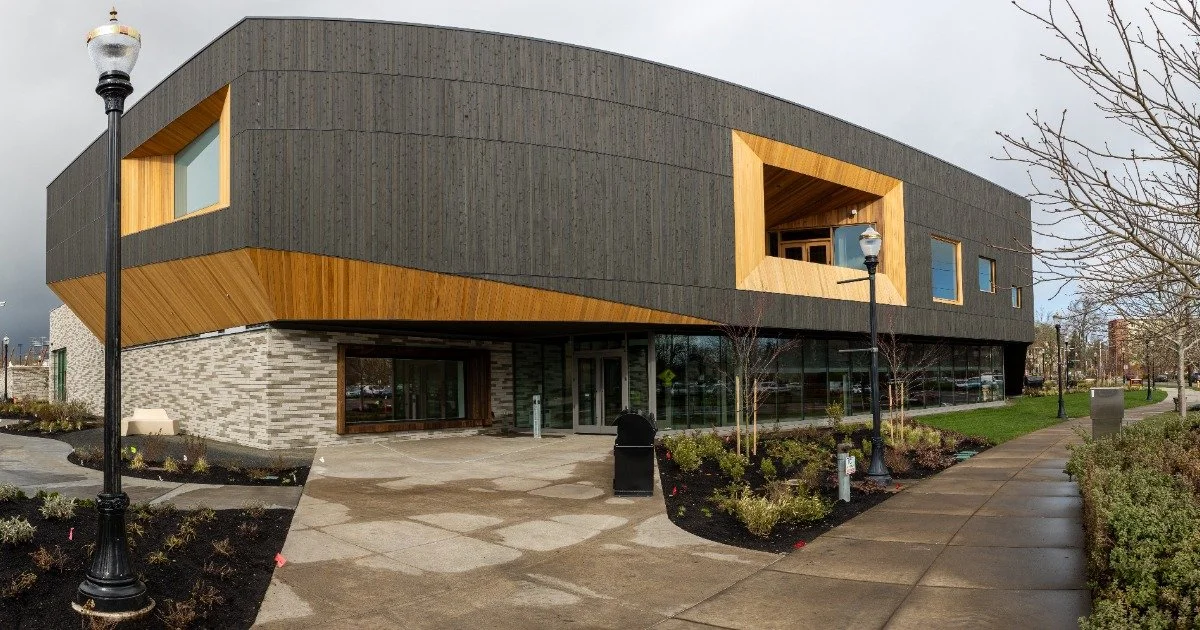
ABOUT THE VENUES

UP NEXT AT 3A

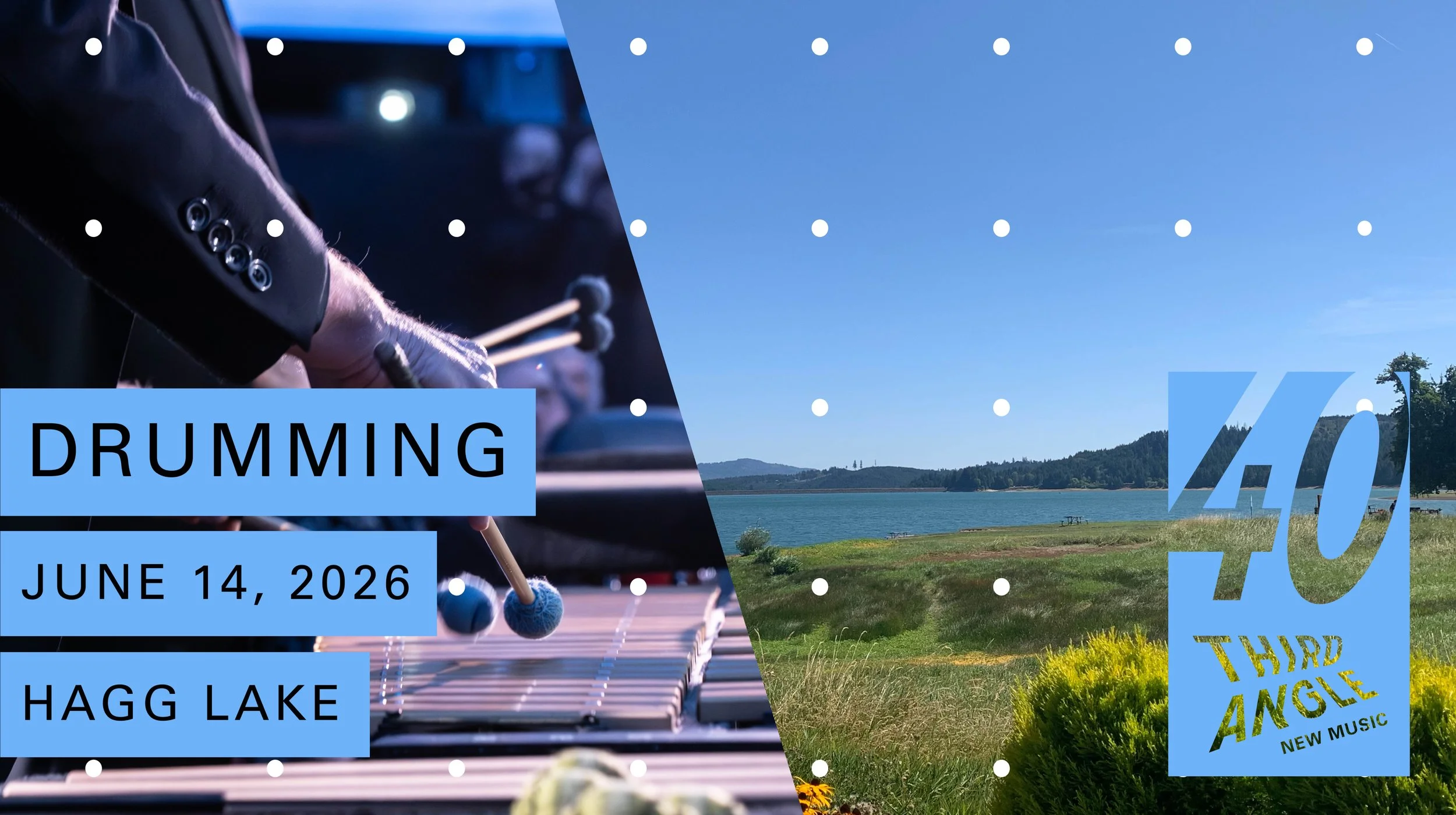
Join Third Angle and PSU Percussion on the wooded banks of Henry Hagg lake for Steve Reich’s Drumming, an epic meditation on phasing inspired by Reich’s own studies with Ghanaian master drummers. FREE show!